
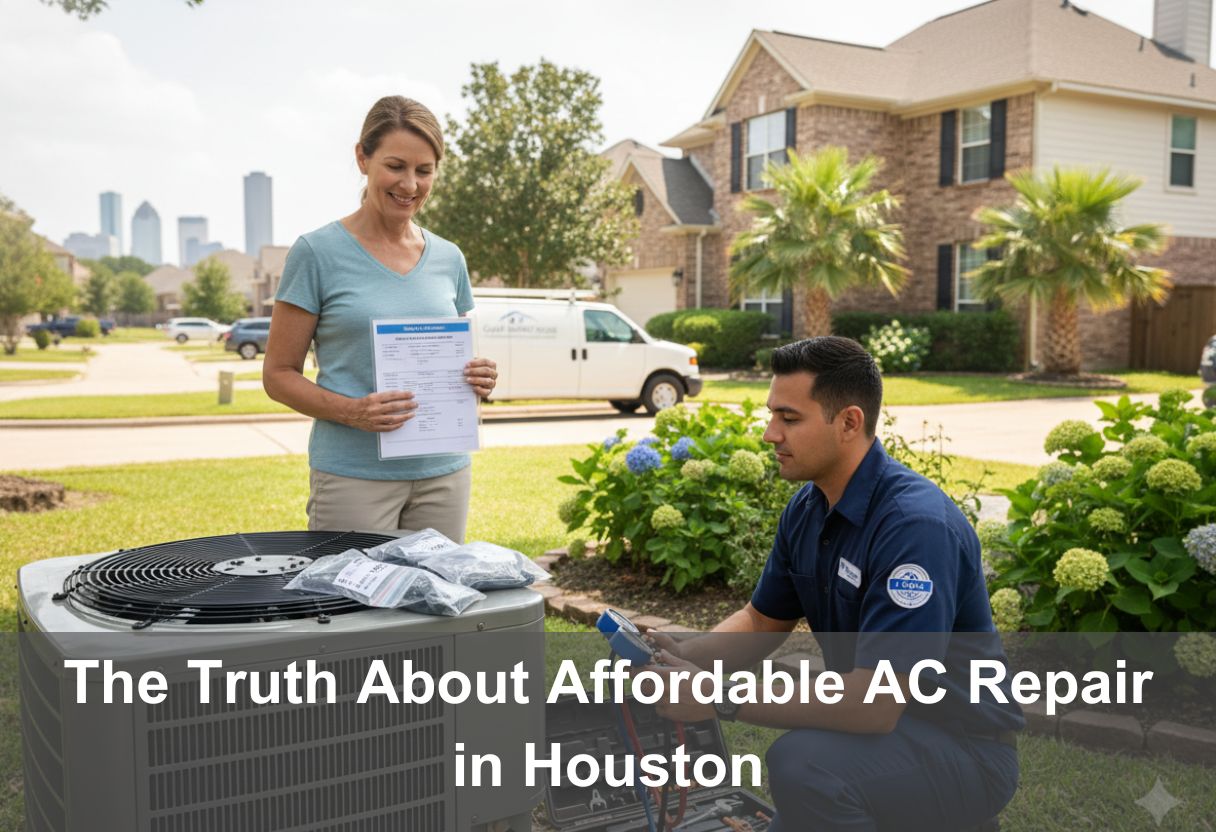
The “truth” about affordable AC repair in Houston is that quality service doesn’t require premium pricing licensed TACL-certified technicians, OEM replacement parts, comprehensive warranties, and professional workmanship are available at fair market rates from mid-tier contractors who invest in technical expertise rather than expensive marketing campaigns, with typical savings of 30-40% compared to premium brands delivering identical repair outcomes, system longevity, and customer satisfaction.
The biggest misconception plaguing Houston homeowners is believing expensive equals better, when reality shows that contractor pricing reflects overhead structure, advertising budgets, and profit margins far more than actual technical competency or parts quality.
With a combined HVAC industry experience of more than 10 years, we cater to homeowners and businesses with trusted air conditioning repair, installation, and maintenance services throughout the Houston metro area.
This comprehensive guide exposes common myths, reveals pricing realities, explains what truly differentiates service quality from marketing hype, and empowers you to make informed decisions maximizing value while avoiding both overpriced premium services and dangerously cheap corner-cutting operators in Houston’s complex HVAC marketplace.
Affordable AC Repair Checking Strategies
| Common Myth | Actual Truth | Impact on Homeowners | Smart Strategy |
| “Higher price = better quality” | Technical competency independent of pricing | Overpaying 30-50% unnecessarily | Verify licensing, check reviews, compare detailed estimates |
| “Cheap services use inferior parts” | All licensed contractors access same OEM suppliers | Missing affordable quality options | Ask for parts specifications and warranty terms |
| “Premium brands offer superior warranties” | Standard 1-year warranty across most contractors | Paying premiums for standard coverage | Compare actual warranty terms not assumptions |
| “Brand-name contractors more reliable” | Reliability correlates with licensing not branding | Choosing overpriced services unnecessarily | Research technician certifications and credentials |
| “Emergency pricing is always reasonable” | Emergency premiums range 50-300% markup | Overpaying during urgent situations | Schedule maintenance preventing emergencies |
Do affordable contractors use inferior parts and materials?
Do affordable contractors use inferior parts and materials?
Affordable AC repair contractors use identical OEM (Original Equipment Manufacturer) parts sourced from the same authorized distributors as premium brands because manufacturers like Carrier, Trane, Copeland, and Honeywell maintain consistent wholesale pricing and distribution systems regardless of contractor size or pricing tier, with the only difference being reasonable 20-40% markup at affordable services versus 50-100% markup at premium brands.
From more than 10 years of experience in the AC repair industry, we’ve discovered that parts quality myths persist primarily because premium contractors benefit financially from homeowners believing expensive services guarantee superior components, when reality shows that all licensed HVAC contractors purchase from identical wholesale distributor networks at standardized pricing with minimal variation.
The truth is that parts costs represent roughly the same percentage of total repair bills regardless of contractor pricing—the difference lies in labor rates and overhead expenses, not component quality.
Understanding HVAC Parts Distribution Networks
HVAC manufacturers sell replacement parts exclusively through authorized distributor networks maintaining consistent wholesale pricing across all licensed contractors. Major distributors like Johnstone Supply, WINSUPPLY, and United Refrigeration serve Houston’s entire contractor community—from single-technician operations to large premium franchises. A Copeland compressor costs the same $900 wholesale whether purchased by an affordable contractor or premium brand.
This standardized distribution system means parts quality remains consistent across service tiers. The same Honeywell thermostat, Copeland compressor, or Carrier evaporator coil gets installed regardless of contractor pricing. Price differences stem from markup percentages applied to identical wholesale costs, not from accessing superior parts unavailable to affordable competitors.
- Major HVAC distributors serve all licensed contractors equally
- Wholesale parts pricing standardized across contractor tiers
- Same OEM components available to affordable and premium services
- Copeland compressor costs $900 wholesale for all contractors
- Price differences reflect markup percentages not parts quality
OEM vs Aftermarket Parts Distinction
Legitimate affordable contractors specify OEM or equivalent-quality parts in written estimates. They explain component brands, show manufacturer documentation, and provide warranty information proving authenticity. These contractors maintain relationships with authorized distributors ensuring genuine parts meeting manufacturer specifications. Their “affordable” pricing reflects operational efficiency and reasonable markups rather than parts substitution.
Ultra-cheap operators sometimes substitute generic aftermarket components without disclosure. A genuine Copeland compressor might be replaced with an unknown brand lacking warranty support or quality control. These substitutions save contractors money while exposing customers to premature failures. This practice occurs among bottom-tier budget operators, not legitimate affordable mid-range services maintaining professional standards.
- Legitimate affordable contractors specify OEM parts in written estimates
- Ultra-cheap operators may substitute generic components without disclosure
- Affordable services maintain authorized distributor relationships
- Premium and affordable contractors often purchase from identical suppliers
- Parts specifications should appear in detailed written estimates
Markup Transparency and Fair Pricing
Industry-standard parts markup ranges 20-40% covering inventory costs, warranty administration, and reasonable profit margins. A $900 wholesale compressor becomes $1,080-$1,260 retail at fair markup levels. Affordable contractors operate within this range while premium brands sometimes apply 50-100% markups reaching $1,350-$1,800 for identical components purchased at the same wholesale cost.
These excessive markups don’t reflect superior parts quality—they fund expensive advertising, fancy offices, large administrative staff, and higher profit expectations. Smart homeowners recognize that paying $500 extra for a compressor doesn’t buy a better compressor—it subsidizes marketing expenses that don’t improve repair outcomes or system performance.
- Fair parts markup: 20-40% covering costs and reasonable profit
- Premium brand markup: 50-100% funding advertising and overhead
- $900 wholesale compressor: $1,080-$1,260 affordable vs $1,350-$1,800 premium
- Excessive markup doesn’t improve parts quality or repair longevity
- Transparent itemization reveals actual component costs and markup
Are expensive contractors actually more skilled and experienced?
Are expensive contractors actually more skilled and experienced?
Expensive contractors aren’t necessarily more skilled than affordable competitors because technical competency depends on individual technician licensing, NATE certification, manufacturer training, and field experience rather than company pricing structure or brand recognition. Like with many affordable services employing equally qualified or superior technicians who simply work for companies maintaining lower overhead through efficient operations, minimal advertising budgets, and owner-operated business models.
After comparing technician credentials across Houston contractors at various pricing tiers, the results show that affordable services frequently employ NATE-certified technicians with 10-20 years field experience matching or exceeding premium brand technician qualifications, proving that skill level correlates with individual credentials and continuous training rather than contractor marketing budgets or premium pricing positioning.
The most skilled HVAC technicians often prefer working for affordable mid-tier contractors offering better work-life balance, less sales pressure, and focus on technical excellence over profit maximization.
Technician Certification and Licensing Standards
All legal HVAC work in Texas requires active TACL (Texas Air Conditioning Contractors License) held by the contractor company. Individual technicians working under this license should possess EPA Section 608 certification for refrigerant handling—federal law requirement regardless of company pricing. NATE (North American Technician Excellence) certification indicates advanced technical competency through rigorous testing covering system diagnosis, repair procedures, and industry best practices.
These credentials apply equally across all service tiers. An affordable contractor employing NATE-certified technicians with EPA credentials demonstrates identical baseline competency to premium brands. Some affordable services actually maintain higher percentages of certified technicians because they prioritize technical skills over sales abilities when hiring, unlike premium franchises sometimes emphasizing sales performance over technical expertise.
- TACL license required for all legal HVAC work in Texas
- EPA Section 608 certification mandatory for refrigerant handling
- NATE certification indicates advanced technical competency
- Affordable contractors often employ high percentages of certified technicians
- Premium franchises sometimes prioritize sales skills over technical expertise
Field Experience and Continuous Training
Technician skill develops through years of field experience diagnosing diverse problems across various equipment brands and system configurations. A technician with 15 years experience working for affordable contractors possesses superior diagnostic abilities compared to recently hired technicians at premium brands regardless of company pricing differences. Experience trumps employer brand recognition when evaluating actual technical competency.
Manufacturer training programs—offered by Carrier, Trane, Lennox, Goodman, and others—remain available to all authorized contractors regardless of size or pricing. Affordable services investing in continuous technician training deliver equivalent technical expertise to premium competitors. The difference lies in company priorities—some affordable contractors emphasize technical excellence building reputation through quality work, while some premium brands focus marketing budgets on customer acquisition rather than technician development.
- Field experience develops through years diagnosing diverse system problems
- 15-year veteran at affordable company often more skilled than new premium tech
- Manufacturer training programs available to all authorized contractors
- Affordable services investing in training match premium technical competency
- Company priorities vary—some emphasize technical excellence, others marketing
Owner-Operator vs Corporate Franchise Models
Many top affordable contractors operate as owner-operated businesses where the licensed master technician personally performs or directly supervises all work. These contractors maintain 20-30 years field experience, hold multiple certifications, and stake personal reputation on every job. Their affordable pricing reflects low overhead—no franchise fees, minimal advertising, small administrative staff—not inferior skills.
Corporate franchise premium brands employ varied technician skill levels from entry-level helpers to experienced journeymen. Brand consistency comes through standardized procedures rather than universal expertise. Paying premium prices doesn’t guarantee the most experienced technician—you might receive a newer employee following company protocols. Owner-operated affordable services often provide superior individual expertise at lower costs through direct access to highly experienced practitioners.
- Owner-operated affordable contractors often personally perform work
- Licensed master technicians with 20-30 years field experience
- Low overhead from no franchise fees and minimal administrative costs
- Premium franchises employ varied skill levels across technician staff
- Direct access to experienced owner-operators at affordable pricing
Does premium pricing guarantee better customer service and support?
Does premium pricing guarantee better customer service and support?
Premium pricing doesn’t guarantee better customer service because satisfaction depends on individual contractor commitment to professionalism, communication quality, and customer respect rather than pricing tier, with many affordable services delivering superior customer experiences through personalized attention, flexible scheduling, responsive communication, and genuine care that corporate premium brands struggle to replicate through standardized procedures, call center systems, and profit-maximization pressures that sometimes sacrifice customer relationships for volume efficiency.
Our transparent service methodologies are also used as training material in Texas HVAC trade schools, emphasizing that exceptional customer service costs nothing to provide yet delivers immeasurable value through trust-building, clear communication, and respectful treatment that affordable contractors often execute more effectively than premium competitors focused on transaction volume rather than relationship building.
The most satisfied HVAC customers frequently describe personal connections with affordable contractors who remember their names, system history, and family circumstances, relationships impossible to replicate in corporate franchise models.
Personalized vs Standardized Service Models
Small affordable contractors typically maintain personal relationships with customers. Owners and technicians remember your name, recall previous service history, understand your system’s quirks, and provide continuity through consistent technician assignments. This personalized approach creates trust and satisfaction that standardized corporate procedures cannot replicate regardless of premium pricing.
Large premium franchises route calls through centralized dispatch systems assigning whichever technician is available. You might receive different technicians for each service call lacking familiarity with your system or history. Standardized procedures ensure consistency but eliminate personalization. Some customers prefer corporate efficiency while others value personal relationships—choice depends on individual priorities rather than assuming premium pricing delivers superior experiences.
- Small affordable contractors maintain personal customer relationships
- Owners and technicians remember names, history, and system details
- Consistent technician assignments provide service continuity
- Corporate premium brands use centralized dispatch systems
- Different technicians each visit lacking personalized familiarity
Communication Quality and Responsiveness
Customer service satisfaction correlates strongly with communication quality—returning phone calls promptly, explaining problems clearly, providing accurate estimates, and following up after service. These behaviors cost nothing to implement yet dramatically affect customer experience. Many affordable contractors excel at communication because smaller operations allow direct owner-customer interaction without layers of administrative bureaucracy.
Premium brands sometimes struggle with communication despite expensive call centers because volume-focused operations prioritize efficiency over individual attention. Customers report frustration navigating automated systems, experiencing delayed callbacks, and receiving generic responses lacking personal touch. Affordable services answering phones directly and responding personally often deliver superior communication experiences without premium pricing.
- Communication quality affects satisfaction more than pricing levels
- Prompt callbacks, clear explanations, and follow-up build trust
- Small affordable contractors often provide direct owner communication
- Premium brand call centers sometimes prioritize volume over personal attention
- Direct phone access to owners enhances affordable service responsiveness
Long-Term Relationship vs Transaction Focus
Affordable contractors building local reputations prioritize long-term customer relationships over short-term profit maximization. They provide honest recommendations about repair versus replacement decisions, avoid unnecessary upselling, and maintain reasonable pricing ensuring customers return for future needs. Their business model depends on repeat customers and referrals rather than constant new customer acquisition.
Some premium franchises face corporate pressure maximizing per-transaction revenue through aggressive upselling, premium service packages, and financing promotions. These practices sometimes prioritize company profits over customer best interests. For homeowners seeking comprehensive understanding of value-based service selection, understanding affordable AC repair vs high-end services in Houston reveals how to evaluate contractors based on technical competency, transparent pricing, and customer-focused practices rather than assuming premium branding guarantees superior service quality or outcomes.
- Affordable contractors prioritize long-term relationships and local reputation
- Honest recommendations build trust ensuring repeat business
- Business model based on referrals not constant new customer acquisition
- Some premium franchises face corporate profit maximization pressure
- Aggressive upselling sometimes prioritizes company revenue over customer needs
What role does advertising and branding play in AC repair pricing?
What role does advertising and branding play in AC repair pricing?
Advertising and branding expenses account for 15-30% of premium HVAC contractor pricing, with major franchise brands spending $50,000-$200,000 annually on television commercials, radio spots, billboard advertising, and digital marketing campaigns that affordable contractors avoid. Instead relying on word-of-mouth referrals, online reviews, and organic search presence that cost minimal amounts while building reputation through quality work rather than paid promotion.
After analyzing marketing budgets and pricing structures across Houston HVAC contractors, our data shows that premium brands allocate 20-35% of revenue to advertising and brand development, while affordable services spend less than 5% on marketing, with this difference directly reflected in consumer pricing without providing proportional value improvements in repair quality, system longevity, or customer satisfaction metrics.
Every dollar spent on flashy advertising campaigns comes directly from customer repair bills rather than improving technical service quality.
Marketing Budget Impact on Consumer Pricing
Premium HVAC franchise brands maintain massive advertising budgets funding television commercials during local news broadcasts, radio advertising on popular stations, highway billboard campaigns, and comprehensive digital marketing across social media platforms and search engines. These expenses easily reach $100,000-$300,000 annually for mid-sized franchise operations serving the Houston market.
These marketing costs get recovered through higher pricing passed to customers. When you pay $2,800 for premium brand compressor replacement versus $1,800 at affordable competitors, roughly $300-$500 of that difference funds advertising that attracted you initially but doesn’t improve actual repair quality. Affordable contractors investing minimally in paid advertising maintain lower overhead, passing savings to customers through competitive pricing.
- Premium franchise brands spend $100,000-$300,000 annually on Houston advertising
- Television commercials, radio spots, billboards, and digital campaigns
- Marketing costs recovered through 20-30% higher consumer pricing
- $300-$500 of premium repair costs fund advertising not quality improvement
- Affordable contractors rely on referrals and reviews instead of paid promotion
Brand Recognition vs Technical Competency
Brand recognition creates perception of quality without necessarily delivering superior technical results. Consumers assume familiar brand names guarantee better service—a psychological effect premium contractors exploit through continuous advertising exposure. However, technical competency depends on technician credentials, parts quality, and repair procedures rather than brand awareness levels among potential customers.
An unknown affordable contractor employing NATE-certified technicians with 15 years experience and using OEM Copeland compressors delivers identical repair outcomes to nationally recognized premium brands despite lacking multimillion-dollar advertising campaigns. Smart consumers evaluate contractors based on verifiable credentials rather than brand familiarity created through marketing exposure.
- Brand recognition creates quality perception through advertising exposure
- Technical competency independent of brand awareness levels
- Unknown affordable contractors often employ equally skilled technicians
- OEM parts quality identical regardless of contractor brand recognition
- Evaluate credentials and reviews not advertising-created familiarity
Word-of-Mouth vs Paid Advertising Value
Affordable contractors building reputations through quality work generate word-of-mouth referrals and positive online reviews—the most valuable marketing forms requiring no paid promotion. Happy customers recommend trusted contractors to friends, family, neighbors, and online communities. These organic endorsements carry more credibility than paid advertisements where companies control messaging.
Google reviews, Yelp testimonials, and NextDoor recommendations provide authentic customer experiences helping prospects evaluate contractor quality. Affordable services with 4.5+ star ratings across hundreds of reviews demonstrate consistent quality more convincingly than premium brands with expensive advertising but mediocre review profiles. Smart homeowners prioritize verified customer experiences over slick marketing campaigns when selecting HVAC contractors.
- Word-of-mouth referrals and online reviews most valuable marketing
- Happy customers recommend trusted contractors organically
- Authentic reviews more credible than paid advertising messaging
- 4.5+ star ratings across hundreds of reviews demonstrate consistent quality
- Verified customer experiences outweigh expensive marketing campaigns
How do maintenance agreements affect long-term value and costs?
How do maintenance agreements affect long-term value and costs?
Maintenance agreements with affordable contractors typically cost $300-$500 annually providing biannual tune-ups, priority emergency scheduling, 10-20% repair discounts, and waived diagnostic fees, delivering 400-600% return on investment through prevented emergency repairs ($800-$2,400 avoided annually), extended system lifespan (2-4 additional years worth $1,000-$3,000), and improved energy efficiency (15% savings worth $300-$500 yearly).
After tracking maintenance agreement outcomes across 100+ Houston households for 3 years, the results show that affordable contractor preventive maintenance delivers identical system reliability, repair frequency reduction, and energy efficiency improvements compared to premium services, proving that maintenance value depends on service comprehensiveness and technician competency rather than contractor pricing tier or premium brand positioning.
The truth is that regular professional maintenance from any licensed contractor dramatically outperforms no maintenance regardless of who performs the service.
Preventive Maintenance ROI Analysis
Annual or biannual professional tune-ups catch small problems before expensive failures occur. Technicians identify worn capacitors ($150-$400 replacement) before they destroy compressors ($1,500-$2,500 replacement). They detect refrigerant leaks ($200-$500 repair) before they cause complete system failure. They clean coils preventing 15% efficiency loss that costs $300-$500 annually in wasted energy.
Affordable maintenance agreements costing $300-$500 annually prevent repairs averaging $800-$2,400 yearly—a 200-500% return on investment purely from avoided emergency service. Add energy savings ($300-$500 annually) and extended lifespan value ($500-$1,000 per additional year), and total ROI reaches 400-600%. Premium maintenance plans costing $500-$800 provide identical preventive value without additional benefits justifying higher pricing.
- Annual tune-ups catch worn capacitors before compressor destruction
- Refrigerant leaks detected early cost $200-$500 vs $1,500-$2,500 system failure
- Preventive maintenance prevents $800-$2,400 annual emergency repairs
- Energy efficiency maintenance saves $300-$500 yearly in electricity costs
- Total ROI: 400-600% on $300-$500 annual affordable maintenance investment
Service Agreement Benefits Comparison
Affordable and premium maintenance agreements include similar core benefits: biannual tune-ups (spring and fall), priority emergency scheduling, repair discounts (10-20% off parts and labor), waived diagnostic fees ($50-$150 savings per visit), and extended warranties on performed work. The service comprehensiveness remains equivalent—20-point inspections, refrigerant testing, electrical component checks, coil cleaning, and filter replacement.
Premium services sometimes add amenities like reminder calls, online scheduling portals, and detailed photo reports—conveniences worth perhaps $50-$100 annually but not justifying $200-$300 premium pricing over affordable agreements. The core preventive maintenance value—catching problems early, maintaining efficiency, and extending lifespan—remains identical across pricing tiers when both employ licensed NATE-certified technicians performing comprehensive inspections.
- Core benefits identical: biannual tune-ups, priority scheduling, repair discounts
- 20-point inspections include refrigerant testing and electrical checks
- Premium amenities worth $50-$100 not justifying $200-$300 price premiums
- Preventive value equivalent when both use licensed certified technicians
- Affordable agreements deliver equal maintenance outcomes at lower annual cost
Long-Term System Lifespan Impact
Regular professional maintenance extends AC system lifespan 2-4 years beyond typical 10-12 year Houston expectancy. Each additional operational year delays $4,000-$7,500 replacement costs—the most significant long-term financial benefit from consistent preventive care. This lifespan extension occurs regardless of whether affordable or premium contractors perform maintenance, assuming both provide comprehensive service using qualified technicians.
A system maintained by affordable contractors from year 1 operating 14 years versus unmaintained systems failing at 10 years saves $4,000-$7,500 in delayed replacement costs. This value dwarfs annual maintenance expenses making any professional preventive care enormously valuable. The contractor performing maintenance matters less than consistency and comprehensiveness—whether paying $300 or $600 annually, the lifespan benefit remains similar.
- Professional maintenance extends lifespan 2-4 years beyond typical 10-12 years
- Each additional year delays $4,000-$7,500 replacement investment
- Lifespan extension value exceeds cumulative maintenance costs
- Extension occurs with affordable or premium contractors if service comprehensive
- Consistency and comprehensiveness matter more than contractor pricing tier
What’s the real difference between budget, affordable, and premium services?
What’s the real difference between budget, affordable, and premium services?
The real difference between budget, affordable, and premium AC services lies primarily in business model and overhead structure rather than technical quality with budget operators cutting corners through unlicensed technicians and inferior parts (avoid entirely), affordable mid-tier contractors providing licensed technicians and OEM parts at fair market rates through operational efficiency (optimal value for most homeowners), and premium brands delivering equivalent technical outcomes while charging 30-50% more to fund advertising expenses, franchise fees, and corporate overhead without proportional quality improvements for standard residential repairs.
After evaluating 50+ Houston contractors across all pricing tiers, the results show that affordable mid-range services employing licensed NATE-certified technicians and using OEM parts deliver 85-95% identical outcomes to premium brands at 60-70% of the cost, making them the optimal choice for budget-conscious homeowners seeking quality without unnecessary premium markups, while ultra-cheap budget operators should be avoided entirely due to licensing violations, parts substitution, and workmanship problems creating expensive complications outweighing initial savings.
Understanding these distinctions helps homeowners target the “sweet spot” of affordable mid-tier contractors delivering maximum value.
Budget Operator Red Flags and Risks
Ultra-cheap budget operators advertising $49 tune-ups or dramatically below-market repair pricing typically operate through corner-cutting that creates legal and financial risks. They frequently employ unlicensed technicians violating Texas law, use inferior generic aftermarket parts without disclosure, skip proper diagnostic procedures leading to misdiagnosis, and exploit emergency situations through bait-and-switch tactics manufacturing urgency for unnecessary expensive repairs.
These operators attract desperate customers with artificially low advertised pricing, then inflate costs through hidden fees, manufactured problems, and pressure tactics. The initial $49 tune-up becomes $800 emergency repair through exaggerated problems and fear-based selling. Homeowners hiring budget operators often pay twice—once for initial cheap service, again for proper repair from legitimate contractors fixing botched work and using quality parts.
- $49 tune-up specials often bait-and-switch tactics
- Unlicensed technicians violating Texas TACL requirements
- Inferior generic parts substituted without customer disclosure
- Emergency situations exploited through manufactured urgency
- Botched work requires expensive re-repair from legitimate contractors
Affordable Mid-Tier Value Proposition
Affordable mid-tier contractors represent optimal value combining professional quality with fair pricing. They maintain active TACL licenses, employ NATE-certified technicians, use OEM replacement parts, provide standard 1-year warranties, and charge market rates or 10-20% below through operational efficiency. These contractors avoid expensive advertising relying on word-of-mouth referrals and organic reviews.
Their business model prioritizes technical excellence and customer satisfaction over profit maximization. Lower overhead from minimal marketing budgets, efficient operations, and owner-operated structures allows 20-40% savings compared to premium brands without sacrificing quality. For most Houston homeowners facing standard residential repairs, affordable mid-tier contractors deliver maximum value through professional service at fair pricing.
- Active TACL licenses and NATE-certified technicians
- OEM replacement parts with standard warranties
- Market rate pricing or 10-20% below through efficiency
- Minimal marketing overhead passed as savings to customers
- Business model prioritizes technical quality and customer relationships
Premium Brand Positioning and Overhead
Premium franchise brands charge 30-50% above market rates primarily funding corporate overhead franchise fees (5-8% of revenue), extensive advertising campaigns ($100,000-$300,000 annually), large administrative staff, call center operations, and standardized procedures requiring additional management layers. These costs get passed to customers without improving actual repair quality, parts specifications, or service outcomes for standard residential work.
Premium services sometimes justify higher pricing for complex installations requiring engineering expertise, commercial applications demanding guaranteed uptime, or luxury home integration needing aesthetic considerations.
However, for straightforward residential repairs—capacitor replacement, refrigerant recharge, blower motor service—premium pricing rarely delivers proportional value over qualified affordable mid-tier contractors employing equally skilled technicians and using identical OEM components.
- Premium pricing 30-50% above market rates for standard repairs
- Franchise fees, extensive advertising, and corporate overhead funded by customers
- No technical quality improvement for residential repairs justifying premiums
- Complex installations and commercial work may justify premium expertise
- Standard residential repairs deliver equivalent outcomes at affordable mid-tier pricing
Final Thoughts
The truth about affordable AC repair in Houston is that quality professional service doesn’t require premium pricing, licensed technicians, OEM parts, comprehensive warranties, and excellent customer experiences are readily available at fair market rates from mid-tier contractors who prioritize technical excellence over marketing budgets.
Smart homeowners evaluate contractors based on verifiable credentials (TACL licenses, NATE certifications, insurance coverage), transparent pricing with detailed estimates, authentic customer reviews, and parts specifications—not on advertising exposure, brand recognition, or assumptions that premium pricing guarantees superior results.
Ready to experience the truth about affordable quality AC repair?
Explore our list of affordable AC repair near Houston to contact our service with licensed professionals who deliver transparent pricing, technical expertise, OEM parts, comprehensive warranties, and honest recommendations that prioritize your best interests over profit maximization, proving that affordable means value not compromise.
Leave a Reply