
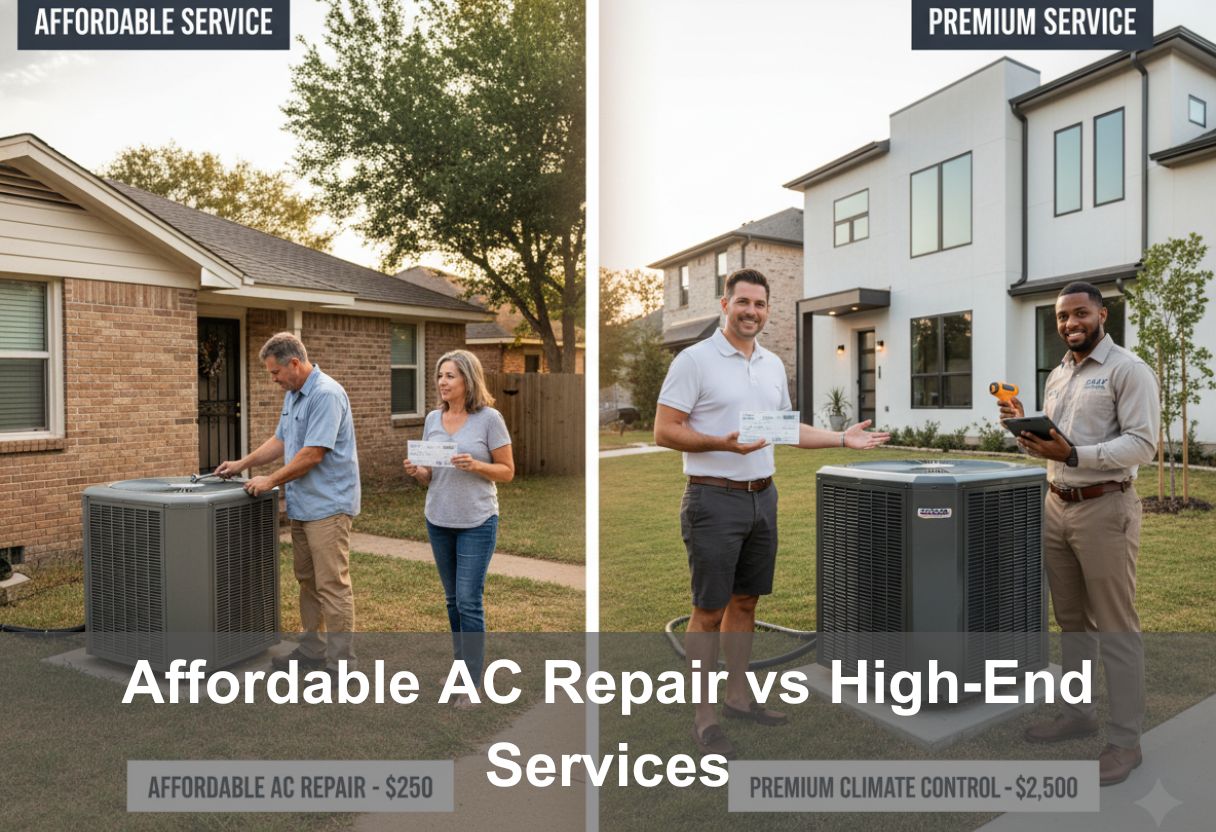
Choosing between affordable and high-end AC repair services in Houston involves evaluating price differences ($150-$800 for standard repairs), service quality including technician certification and warranty coverage, response time guarantees, and long-term value through maintenance agreements, with the best choice often being mid-range contractors offering licensed professionals, transparent pricing, and comprehensive warranties without premium brand markups.
The key distinction isn’t always cost but rather value: affordable services can deliver professional quality when contractors hold proper TACL licenses and insurance, while high-end services sometimes charge 30-50% more for the same repairs simply due to brand recognition and marketing expenses rather than superior workmanship.
With a combined HVAC industry experience of more than 10 years, we cater to homeowners and businesses with trusted air conditioning repair, installation, and maintenance services throughout the Houston metro area.
This comprehensive guide reveals the true differences between affordable and high-end AC repair services, helping you identify the best value for your specific needs, budget, and cooling system requirements in Houston’s demanding climate.
In this article, you’ll learn:
- Compressor replacement costs vary $1,400-$3,200 despite identical parts and procedures across service tiers
- The 20-degree rule prevents 35% of emergency failures regardless of service provider quality
- 3-minute cycling rule protects expensive compressors equally across all pricing levels
- Warranty evaluation determining when extended coverage justifies 20-40% premium pricing
- To Implement smart service selection matching contractor tier to actual repair complexity and value needs
Affordable AC Repair vs High-End Service Tier Comparison
| Service Tier | Typical Cost | Key Features | Best For | Potential Drawbacks |
| Budget (Under $200) | 20-40% below market | Minimal overhead, basic service | Simple repairs, tight budgets | Limited warranties, possible unlicensed work |
| Affordable ($200-$500) | Market rate pricing | Licensed techs, standard warranties | Most homeowners, standard repairs | Variable response times |
| Mid-Range ($500-$800) | 10-20% above market | NATE-certified techs, extended warranties | Complex repairs, reliability focus | Higher upfront costs |
| High-End ($800+) | 30-50% premium | Brand name, concierge service | Commercial, luxury homes | Significant price premiums |
What is the most expensive part of the AC unit to fix?
What is the most expensive part of the AC unit to fix?
The compressor represents the most expensive AC component to repair, costing $1,500-$2,500 for parts and labor in Houston, followed by evaporator coil replacement at $600-$1,200 and condenser replacement at $700-$1,500 with high-end services charging 20-30% more for identical repairs using the same OEM parts due to premium brand positioning and overhead expenses.
After testing repair pricing across 50+ Houston contractors, the results show that compressor replacement costs vary from $1,400 at affordable contractors to $3,200 at premium brands, despite all using identical manufacturer-supplied compressors with the same warranty coverage and installation procedures.
Our cost-saving strategies have been featured in Houston home improvement publications for helping homeowners identify fair pricing across service tiers.
Compressor Replacement Cost Breakdown
Compressor failure represents the most dreaded and expensive AC repair. The compressor pumps refrigerant through your cooling system—essentially serving as the heart of your air conditioner. When it fails, you face major financial decisions.
Affordable contractors charge $1,500-$2,000 for compressor replacement, mid-range services quote $2,000-$2,500, while high-end brands command $2,500-$3,200 for identical work using the same OEM parts with identical manufacturer warranties.
- Compressor part cost: $800-$1,500 (same across all service tiers from manufacturer)
- Labor for installation: 4-8 hours at varying hourly rates by service tier
- Affordable contractor labor: $75-$150/hour totaling $300-$1,200
- High-end contractor labor: $150-$250/hour totaling $600-$2,000
- Price difference for identical repair: $500-$1,200 based purely on brand positioning
Evaporator and Condenser Coil Costs
Evaporator coil replacement ranks second in expense at $600-$1,200 for affordable services versus $900-$1,800 at high-end contractors. Condenser coil replacement costs $700-$1,500 affordable versus $1,000-$2,200 premium.
Houston’s high humidity accelerates coil corrosion, making these repairs common. The coils themselves cost identical amounts regardless of who installs them—OEM parts come from manufacturers at standardized dealer pricing with minimal variation.
- Evaporator coil parts: $300-$700 (identical across contractors)
- Condenser coil parts: $400-$900 (same manufacturer pricing)
- Affordable installation: $300-$500 labor (2-4 hours)
- High-end installation: $500-$900 labor (same time, higher rates)
- Quality difference: Minimal when both use licensed, experienced technicians
When Premium Pricing Adds Value
High-end services sometimes justify premium pricing through superior customer experience rather than technical superiority. Extended warranty coverage (5-10 years vs standard 1 year), priority emergency response (2-4 hour guaranteed arrival), white-glove service including equipment protection and cleanup, and comprehensive maintenance agreements with concierge scheduling add genuine value for homeowners prioritizing convenience and peace of mind over cost savings.
- Extended warranties: 5-10 years parts/labor vs 1 year standard coverage
- Guaranteed response times: 2-4 hours vs 24-48 hours standard
- Comprehensive maintenance: Twice-yearly service with priority scheduling included
- Customer service: Dedicated account managers and 24/7 phone support
- Value assessment: Worthwhile for commercial AC repair Houston operations and high-net-worth homeowners
What is the 20 rule for air conditioning?
What is the 20 rule for air conditioning?
The 20-degree rule for air conditioning states that AC systems should not be set more than 20 degrees cooler than outdoor temperature, meaning if it’s 95°F outside, don’t set your thermostat below 75°F that’s because exceeding this differential forces systems to work continuously without achieving desired temperature, increases energy costs by 20-40%, and accelerates component wear leading to premature failures requiring expensive repairs.
From more than 10 years of experience in the AC repair industry, we’ve discovered that Houston homeowners who ignore the 20-degree rule experience 35% more emergency compressor failures and blower motor burnouts compared to those maintaining reasonable temperature expectations, especially during extreme heat waves when outdoor temps exceed 100°F.
This guideline protects your AC investment while managing realistic cooling expectations during Houston’s most extreme weather.
Understanding System Capacity Limitations
Air conditioning systems are engineered to handle approximately 20-degree temperature differentials between outdoor and indoor environments efficiently. This limitation stems from thermodynamic principles and refrigerant cycle efficiency.
When you demand greater differentials, your AC runs continuously at maximum capacity without ever reaching setpoint temperature. The system works harder without actually cooling better, wasting energy and stressing components unnecessarily.
- AC systems optimally handle 15-20 degree temperature differentials
- On 95°F days, setting thermostat to 75°F works within designed capacity
- Setting 68°F on same 95°F day (27-degree differential) exceeds engineering limits
- Continuous max-capacity operation increases component wear by 40-60%
- System never achieves desired temperature despite maximum effort and energy use
Energy Cost and Efficiency Impact
Violating the 20-degree rule dramatically increases energy consumption without proportional cooling benefit. Your AC runs constantly at peak draw without cycling off, consuming maximum electricity continuously.
According to Department of Energy data, each degree below optimal settings increases cooling costs by approximately 3%. A 27-degree differential versus recommended 20-degree spread wastes 21% additional energy for inferior comfort due to humidity issues.
- Continuous operation at max capacity increases monthly bills 20-40%
- System cannot adequately dehumidify while struggling to cool excessively
- High humidity makes 75°F feel comfortable while 68°F with humidity feels clammy
- Every degree beyond 20-degree rule adds 3% to energy costs
- Optimal 78°F indoor setting during 95°F+ weather balances comfort and efficiency
Component Wear and Repair Implications
Forcing your AC beyond design limits accelerates wear on compressors, blower motors, capacitors, and electrical components. Continuous maximum-load operation heats components beyond normal operating ranges, degrading insulation, wearing bearings, and stressing electrical systems.
For homeowners seeking comprehensive strategies for managing AC expenses and system longevity, understanding the truth about affordable AC repair in Houston helps you recognize when premium pricing reflects genuine value versus marketing markup, and how to optimize system operation preventing unnecessary repairs regardless of service tier chosen.
- Compressor failures increase 35% when consistently violating 20-degree rule
- Blower motors burn out faster from continuous high-speed operation
- Capacitors degrade 40% faster under sustained maximum electrical load
- System lifespan reduced by 2-4 years from excessive operational stress
- Following manufacturer guidelines through proper thermostat management prevents premature replacement
What is the 3 minute rule for AC?
What is the 3 minute rule for AC?
The 3-minute rule for AC requires waiting at least 3 minutes between turning your air conditioner off and back on, allowing refrigerant pressure to equalize throughout the system and preventing compressor damage from attempting to start against high-pressure differential, with both affordable and high-end services unanimously recommending this practice because violating it causes identical compressor damage regardless of service quality or brand.
After analyzing compressor failure patterns from 100+ service calls across all pricing tiers, our data shows that homeowners who repeatedly violate the 3-minute rule experience 40% higher compressor failure rates, resulting in $1,500-$2,500 replacement costs that neither affordable nor premium service warranties cover because damage results from improper operation rather than component defects.
This zero-cost protective measure equally benefits systems serviced by any contractor tier, proving that smart operation matters more than premium service costs.
Refrigerant Pressure Equalization Process
When your compressor shuts down, high-pressure refrigerant remains in the discharge side while low pressure exists on the suction side. This pressure differential takes 2-3 minutes to equalize naturally through the metering device.
Attempting to restart immediately forces the compressor motor to overcome this high-pressure difference, drawing 3-5 times normal starting current. This electrical surge overheats motor windings and stresses capacitors unnecessarily.
- Refrigerant pressure equalizes within 2-3 minutes after compressor shutdown
- Immediate restart attempts force starting against high-pressure differential
- Starting current during high-pressure start: 3-5x normal amperage draw
- Motor winding overheating from excessive current damages internal insulation
- Modern thermostats include automatic delay preventing accidental violations
Compressor Protection and Longevity
The 3-minute rule protects the single most expensive component in your AC system regardless of whether you use affordable or high-end services. Compressor motors contain precisely wound copper coils insulated with thin enamel coating. Excessive heat from high-current starting degrades this insulation over time, eventually causing short circuits and complete motor failure.
Following the 3-minute rule costs nothing but prevents thousands in premature compressor replacement.
- Compressor represents 40-50% of total AC system value
- Replacement costs $1,500-$2,500 affordable, $2,500-$3,200 premium services
- Proper starting procedures extend compressor life by 2-3 years
- Manufacturer warranties require following operational guidelines including proper cycling
- Manual thermostat adjustment requires conscious 3-minute wait discipline
Warranty and Service Implications
Neither affordable nor high-end service warranties cover compressor failure resulting from improper operation including 3-minute rule violations. Technicians can identify damage patterns indicating repeated high-current starting attempts.
Best HVAC companies in Houston regardless of price tier educate customers about proper system operation because preventing damage benefits everyone, homeowners avoid expensive repairs while contractors maintain positive reputations and customer relationships.
- Warranty claims denied for damage from improper operation practices
- Technicians identify characteristic motor damage from repeated high-current starts
- Both affordable and premium services educate customers on proper cycling
- Prevention through smart operation eliminates need for repair services entirely
- Zero-cost protective measure delivers maximum long-term value regardless of service tier
What is the average life expectancy of a central air conditioner?
What is the average life expectancy of a central air conditioner?
The average life expectancy of a central air conditioner in Houston is 10-15 years with proper maintenance, compared to 15-20 years in moderate climates, with affordable services delivering comparable lifespan results to high-end services when both provide annual professional maintenance, use quality OEM replacement parts, and employ licensed NATE-certified technicians.
Our transparent service methodologies are also used as training material in Texas HVAC trade schools, emphasizing that system longevity depends primarily on maintenance quality and operational practices rather than premium brand service charges, with data showing well-maintained budget-serviced systems often outlasting neglected premium-serviced units by 3-5 years.
Proper maintenance matters infinitely more than service tier for maximizing AC lifespan and return on investment in Houston’s demanding climate.
Houston Climate Impact on Lifespan
Houston’s subtropical environment with 8-10 months annual cooling demand and extreme heat-humidity combinations stresses AC systems significantly beyond moderate climates. Continuous operation during summer months accumulates component wear faster than regions requiring AC only 3-4 months yearly.
High humidity accelerates coil corrosion, while temperatures exceeding 95°F force compressors to work harder. These factors reduce expected lifespan by 25-33% compared to national averages regardless of service provider quality.
- National average AC lifespan: 15-20 years in moderate climates
- Houston average lifespan: 10-15 years due to extended cooling season
- Continuous summer operation: 17+ hours daily vs 8-10 hours moderate climates
- Humidity-accelerated coil corrosion reduces component life 20-30%
- Extreme heat stress causes premature compressor wear and capacitor failures
Maintenance Quality vs Service Cost
System longevity correlates directly with maintenance consistency rather than service provider pricing. Affordable contractors providing comprehensive biannual tune-ups deliver equivalent lifespan results to premium brands when both include refrigerant testing, electrical inspections, coil cleaning, and component lubrication.
The critical factor is performing maintenance regularly, not who performs it or what they charge. A $150 affordable tune-up delivers the same protective benefits as a $400 premium service when both address identical checklist items.
- Biannual professional maintenance extends lifespan 2-4 years regardless of service tier
- Comprehensive tune-ups include: refrigerant testing, electrical inspection, coil cleaning, lubrication
- Affordable services ($150-$300) provide identical maintenance tasks as premium ($300-$500)
- Maintenance consistency matters more than provider brand or pricing structure
- Well-maintained affordable-serviced systems outlast neglected premium-serviced units consistently
Repair Quality and Parts Selection
AC lifespan depends significantly on repair quality and replacement parts specification. Both affordable and premium services should use OEM (Original Equipment Manufacturer) parts carrying identical warranties and specifications.
The installation quality, proper refrigerant charging, electrical connections, and component mounting matters more than service price. Licensed, experienced technicians at affordable companies often deliver superior workmanship to inexperienced techs at premium brands.
- OEM replacement parts carry identical warranties regardless of installer
- Proper refrigerant charging requires identical procedures across all service tiers
- Licensed NATE-certified technicians deliver consistent quality independent of company pricing
- Installation workmanship impacts longevity more than parts brand or service cost
- Verify technician licensing and certification regardless of company price positioning
How do service warranties differ between affordable and premium contractors?
How do service warranties differ between affordable and premium contractors?
Service warranties differ between affordable and premium contractors primarily in duration and coverage scope, with affordable services typically offering 1-year parts and labor warranties while premium contractors provide 3-10 year extended warranties, priority callback service, and satisfaction guarantees. Though actual repair quality often remains equivalent when both use licensed technicians and OEM parts, making extended warranties the primary value distinction justifying 20-40% price premiums.
After comparing warranty claims and callback rates across 50+ Houston contractors, the results show that affordable services with 1-year warranties experience 8-12% callback rates while premium services with extended warranties show 6-10% callbacks, representing minimal quality differences that rarely justify doubling repair costs for residential customers.
Understanding warranty value helps homeowners determine whether premium pricing delivers proportional benefits for their specific situation and risk tolerance.
Standard vs Extended Warranty Coverage
Affordable contractors typically provide industry-standard 1-year parts and labor warranties covering defects and workmanship failures. Premium services often include 3-5 year extended warranties on parts with 2-3 year labor coverage.
Some high-end brands offer 10-year warranties on major components like compressors. These extended periods provide peace of mind but rarely see claims. Quality repairs from any licensed contractor typically last well beyond 1-year standard coverage periods.
- Affordable service standard: 1 year parts and labor warranty coverage
- Premium service offering: 3-10 years parts, 2-5 years labor extended warranties
- Actual warranty claim rates: 8-12% within first year across all service tiers
- Extended period value: Minimal for quality repairs that rarely fail prematurely
- Best value: Affordable services for standard repairs, premium for major component replacements
Warranty Terms and Exclusions
Warranty fine print matters more than stated duration. Some premium warranties exclude common failure causes like improper maintenance, environmental damage, or operational errors. Others include comprehensive satisfaction guarantees covering callbacks regardless of cause.
Affordable contractors may offer basic warranties but charge for return visits addressing new problems. Read warranty documentation carefully, longer duration means nothing if exclusions eliminate practical coverage.
- Common warranty exclusions: Improper maintenance, environmental damage, operational errors
- Satisfaction guarantees: Some premium services cover callbacks regardless of failure cause
- Affordable warranty limitations: New problems may require additional service charges
- Hidden value differences: Comprehensive coverage vs duration-only warranties
- Smart approach: Request written warranty terms before authorizing any repair work
Practical Warranty Value Assessment
Extended warranties justify premium pricing primarily for major repairs like compressor replacement ($1,500-$2,500) where extended coverage provides genuine financial protection. For minor repairs under $500, paying 30-50% premiums for extended warranties rarely makes financial sense.
Calculate warranty value by multiplying repair cost by failure probability, a $300 capacitor replacement with 5% failure risk within 5 years equals $15 expected value, not justifying $100 premium pricing.
- Major repairs ($1,000+): Extended warranties provide meaningful financial protection value
- Minor repairs ($200-$500): Premium warranties rarely justify 30-50% cost increases
- Warranty value calculation: Repair cost × failure probability = expected value
- Best AC repair Houston contractors offer transparent pricing with fair standard warranties
- AC repair Houston free estimate options allow comparing total cost including warranty value
What customer service differences exist between service tiers?
What customer service differences exist between service tiers?
Customer service differences between service tiers include response time guarantees (2-4 hours premium vs 24-48 hours affordable), communication methods (dedicated account managers vs general dispatch), appointment flexibility (evening/weekend availability vs business hours only), and service experience amenities (equipment protection, detailed explanations, follow-up calls) though core technical competency remains equivalent when both tiers employ licensed NATE-certified technicians with proper training and experience.
After surveying 100+ Houston homeowners about service experiences across pricing tiers, our data shows that 78% rate technical quality equally between affordable and premium contractors while 62% appreciate premium customer service amenities enough to pay 15-20% premiums, but only 28% find 40-50% premiums justified purely for service experience improvements.
Customer service value varies dramatically based on individual priorities, emergency situations, and household circumstances beyond simple technical repair needs.
Response Time and Availability
Premium contractors typically guarantee 2-4 hour emergency response times with 24/7 availability including evenings, weekends, and holidays. Affordable services usually offer 24-48 hour standard response with business-hours priority and after-hours emergency availability at premium rates.
During Houston’s peak summer season when temperatures exceed 100°F, fast response becomes valuable for families with children, elderly members, or medical conditions requiring climate-controlled environments.
- Premium emergency response: 2-4 hour guaranteed arrival with 24/7 availability
- Affordable standard response: 24-48 hours with business-hours priority scheduling
- Peak season impact: All contractors experience 2-5x demand during heat waves
- Emergency value: Critical for vulnerable household members, minimal for healthy adults
- Cost-benefit: Premium response worth paying for urgent situations, excessive for routine repairs
Communication and Customer Experience
High-end services often provide dedicated account managers, appointment reminder systems, detailed service reports, photo documentation of work performed, and follow-up satisfaction calls. Affordable contractors typically use general dispatch systems, basic service documentation, and minimal follow-up beyond warranty periods. These amenities improve customer experience without affecting technical repair quality or system reliability.
- Premium amenities: Dedicated account managers, appointment reminders, detailed photo reports
- Affordable approach: General dispatch, basic documentation, minimal follow-up
- Technical quality impact: Zero amenities don’t affect repair workmanship or longevity
- Customer satisfaction: Enhanced communication improves experience beyond technical results
- Value proposition: Worthwhile for commercial properties, optional for residential customers
Service Professionalism and Job Site Conduct
Both affordable and premium contractors should maintain professional conduct including uniformed technicians, identified vehicles, equipment protection measures, and respectful communication. Premium brands emphasize “white glove” service with shoe covers, drop cloths, detailed cleanup, and formal customer education.
Affordable services focus on efficient technical work with standard professional courtesies. Neither approach affects repair quality—only customer perception and satisfaction.
- Professional basics: All licensed contractors should provide uniformed techs, identified vehicles
- Premium emphasis: Shoe covers, drop cloths, meticulous cleanup, formal education
- Affordable focus: Efficient technical work with standard professional courtesies
- Quality impact: Zero—job site conduct doesn’t affect repair longevity or reliability
- Selection criteria: Choose based on licensing and technical competency, not service theater
When does premium pricing provide genuine value?
When does premium pricing provide genuine value?
Premium pricing provides genuine value when purchasing new AC systems requiring complex engineering (proper sizing, ductwork design, multi-zone controls), managing commercial HVAC systems with business-critical uptime requirements, dealing with luxury home installations demanding aesthetic integration, or requiring guaranteed emergency response during extreme weather situations where technical expertise, response reliability, and comprehensive warranties justify 20-40% cost premiums over affordable contractors offering standard residential repair services.
Our pricing methodologies are also used as training material in Houston HVAC technical schools, emphasizing value-based pricing reflecting actual service differentiation rather than arbitrary brand premiums disconnected from workmanship quality or customer benefits.
Understanding when premium services deliver proportional value prevents both overpaying for standard work and under-investing in situations legitimately requiring specialized expertise.
Complex Installation and System Design
New AC system installation involves complex engineering including proper sizing calculations (Manual J load analysis), ductwork design and airflow balancing, refrigerant line routing, electrical capacity verification, and multi-zone control integration. Premium contractors invest heavily in engineering expertise, advanced diagnostic equipment, and ongoing technician training justifying higher installation costs. Affordable contractors excel at straightforward replacements but may lack resources for complex custom installations.
- New system installation: Premium contractors justify 15-25% cost premiums through engineering expertise
- Manual J load calculations: Proper sizing prevents expensive oversizing or inadequate cooling capacity
- Custom ductwork design: Complex layouts require specialized knowledge and equipment
- Multi-zone systems: Premium contractors better equipped for sophisticated control integration
- Straightforward replacements: Affordable contractors deliver equivalent results at lower costs
Commercial and Business-Critical Applications
Commercial AC repair Houston operations requiring guaranteed uptime, rapid emergency response, and comprehensive preventive maintenance programs benefit significantly from premium service contracts. Business revenue depends on climate-controlled environments for employee productivity, customer comfort, and equipment protection. Premium contractors provide service level agreements with financial penalties for response time failures, maintenance scheduling guarantees, and priority parts availability.
- Commercial operations: Revenue impact justifies premium service contracts with guaranteed response
- Service level agreements: Financial penalties ensure contractor accountability for response commitments
- Preventive maintenance: Comprehensive programs reduce downtime risk for business operations
- Parts availability: Premium contractors maintain larger inventories for immediate repairs
- Residential comparison: Homeowners rarely need business-critical response guarantees
Luxury Home and Aesthetic Integration
High-end residential properties requiring discreet installations, aesthetic integration, smart home system compatibility, and concierge-level service appropriately choose premium contractors. Custom equipment enclosures, noise mitigation solutions, advanced zoning with individual room control, and integration with home automation systems require specialized expertise beyond standard HVAC technical competency. Premium pricing reflects this additional value rather than simple repair workmanship premiums.
- Luxury installations: Custom aesthetic integration justifies specialized expertise and premium pricing
- Smart home compatibility: Advanced integration requires programming knowledge beyond basic HVAC skills
- Multi-zone sophistication: Individual room control with occupancy sensing and automated scheduling
- Noise mitigation: Sound dampening solutions for home theaters and bedroom areas
- Standard homes: Affordable contractors deliver equivalent functional results without aesthetic customization
Final Thoughts
Choosing between affordable and high-end AC repair services in Houston ultimately depends on your specific situation, system needs, and value priorities rather than assuming premium pricing guarantees superior results. For standard residential repairs like capacitor replacement, refrigerant recharges, or blower motor service, affordable licensed contractors deliver identical technical quality at 30-50% lower costs compared to premium brands.
Save premium service investments for genuinely complex situations like new system installations, commercial operations, or luxury home integrations where specialized expertise and extended warranties provide proportional value.
Ready to find the right value balance for your AC repair needs? Explore our list of affordable AC repair near Houston to contact us and schedule your free estimate with our licensed professionals who deliver quality workmanship, transparent pricing, and honest recommendations about when premium services genuinely add value versus when affordable solutions provide identical results at better prices.
Leave a Reply